 The gospel authors started the original trend. Since then, Christian bookstores have sold untold number of books outlining hundreds of biblical prophecies, all supposedly predicting the life of Jesus. Clearly then, Christians take great comfort in believing that the appearing of Jesus and the events of his life were prophesied long ago by Israelite prophets, all of whom wrote about him in the “Old Testament”.
There’s also another trend. Whenever I talk to some of the most ardent worshipers of Jesus, it quickly becomes apparent that most of them have not read those “prophecies” in their context. They just took the authors’ word for it and used the supposed “proofs” to prop-up their own faith in Jesus and to evangelize the “unbelievers”. I did exactly that when I became a Christian in my late teens. Many of these Christians have become quite proficient at lifting various passages out of the Hebrew Bible, most often as one sentence proof-texts, much the same way the New Testament authors had done. Few care about the violence they do to the original authors’ intent since they believe that this was the authors’ original intent in the first place. In their mind, they sincerely believe that they are doing what G-d wants them to do and that there’s nothing unethical about their methods.
On the other hand, not all of the Christians are that naive. Some of the those who do read these texts in their original context have long realized and acknowledged that most of the supposed Jesus prophecies do not actually foretell the events surrounding the life of Jesus at all nor do they even speak about a messianic king. Rather, by studying those texts closely, they see that these writings speak of wholly different individuals and events, most occurring during the lifetimes of the prophets, many hundreds and even thousands of years prior to Jesus’ birth.
You are probably familiar with books such as All the Messianic Prophecies of the Bible. They list hundreds of Old Testament “prophecies” and their New Testament “fulfillments.” But when we look more closely, we are disappointed because many of them do not seem to predict that Jesus is the Messiah of Nazareth. No wonder many charge that New Testament writers unfairly mined or sloppily plundered the Old Testament for prooftexts to demonstrate Jesus is the Messiah. (Paul Copan, Christian theologian 1)
How then do devout Christians, sincere believers in Jesus like the Dr. Paul Copan, reconcile glaring contradictions that they themselves see between what the prophets actually said and how Christianity later came to use (Jews would say, misuse) Jewish biblical writings to support their belief in Jesus? As it turns out, they have developed various methods and have many explanations at their disposal. Here are but some of them:
- The prophets were indeed predicting people and events wholly different from and completely unrelated to what happened to Jesus, but Jesus still “fulfilled” them, somehow, but in his own way. To these Christians, what is important is not the relevancy or accuracy of original prophecies themselves in regards of the real person of Jesus, but the fact that the “inspired” New Testament authors thought it to be pointing to Jesus and that they were comfortable with using the seemingly unrelated text to fit the unrelated people and events into the life of Jesus. Since the New Testament is “scripture breathed by G-d” on par with the Hebrew Bible, G-d too must have thought such use of the “Old Testament” is perfectly legitimate. Indeed, for them this is the only way to read the Bible as G-d intended!
- Jesus is Israel. Since Jesus is “Israel” personified, he was merely “fulfilling” various Old Testament events pertaining to Israel the nation or assorted Israelites. No matter of whom the context originally spoke, Jesus can be made to fit, allegorically if need be. Therefore, with Jesus being Israel, he was “fulfilling” all the Old Testament and all prophecies can apply to him, no matter the original intent of the writers.
- True, the New Testament writers consciously knew that Jesus didn’t actually fit the original contexts of the “prophecies” that they cited as proofs (even if they prefaced their words with “as it was written”), but they were not really after literal facts. Instead, the New Testament authors were merely writing “midrash” about Jesus, fanciful stories “just like the rabbis” wrote, trying to extract from an unrelated biblical text some deeper hidden meaning.
- The authors of the New Testament viewed the whole of Jewish writings “Christocentrically”. Meaning, even if the original Jewish writers of the Hebrew Bible didn’t mean to write about Jesus, Christians came to believe that they wrote about him anyway, in a mystical way, unbeknownst even to themselves. In fact, for those who hold this view, all of the Old Testament is one big sign post pointing to Jesus. In this way, every single word can be a hidden prophecy or shadow of Jesus, no matter how seemingly unrelated to the original context. It’s all about Jesus.
Of course, the Jewish people, the progeny of the prophets and the original interpreters of the biblical texts who can read them in their original language, the inheritors and keepers of G-d’s Word, have always pointed out these contradictions to Christians. Christians invariably retorted that Jews do not see Jesus in the biblical texts because they have been spiritually blinded, unable to see Jesus “hidden” in the pages of their own scriptures. Modern Christians are not original in such thinking. Indeed, we find that this is exactly the sort of claim made in the New Testament by Apostle Paul:
But their [Jewish] minds were made dull, for to this day the same veil remains when the old covenant is read. It has not been removed, because only in Christ is it taken away. Even to this day when Moses is read, a veil covers their hearts [of Jews]. But whenever anyone turns to the Lord, the veil is taken away. (2 Corinthians 3:14-16)
Yes, some Christians will admit, the Hebrew Scriptures quoted in the New Testament do not actually speak or prophesy of Jesus or of the events of his life as put forth by the gospels. They acknowledge that the Jewish Bible describes other people and other events, as Jews and skeptics always pointed out, and only indirectly or allegorically can be said to speak of Jesus. To Jews who are intimately familiar with their own scriptures this is an unmistakable sign that the claims made by Christianity on behalf of its god are false. To them, Christianity is a false religion that taught millions to worship a man as a deity, a religion that wasn’t averse to misusing Jewish scriptures to achieve its goal.
But does this disturb most Christians? It does some, and many have exited Christianity, especially in the last decade, when alternative sources of information have become readily available on the internet. Ultimately, however, for most Christians belief in Jesus is not about “proofs” – it’s a matter of “faith”, even blind faith based not on investigated facts but on feelings. Millions have become Christians after hearing a convicting message by a preacher and coming up for altar call, or after their family member or a co-worker assured them that Jesus forgives their sins and that without him they are damned to hell. They believed Christian claims without deeply studying and investigating Hebrew scriptures from which Christianity purports to draw its authority. To be a true Christian, one must suspend and fight disbelief and make a sincere effort to believe that Jesus is who Christianity claims him to be. If one does so, he or she has stepped into the light and out of darkness of Satan. Believing makes you believe , and disbelieving or even questioning whether New Testament misuses the Hebrew scriptures can place you into the hands of the devil himself.
The god of this age has blinded the minds of unbelievers, so that they cannot see the light of the gospel that displays the glory of Christ, who is the image of God. (2 Corinthians 4:4)
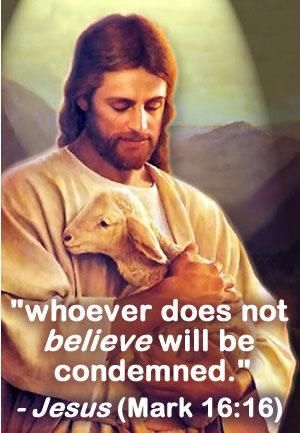
Disbelief in Jesus = eternal damnation (Mark 16:16). It’s little wonder that Christians have an especially strong incentive to “keep the faith” at all costs or that they resort to the methods described above to “prove” Jesus to themselves and to “unbelievers”.
In a future post, I will delve into some of the New Testament’s “prophecies” about Jesus in their original Bible context.
1 Paul Copan, Did New Testament Writers Misquote the Old Testament? (link)


 Daily Minyan
Leave a comment