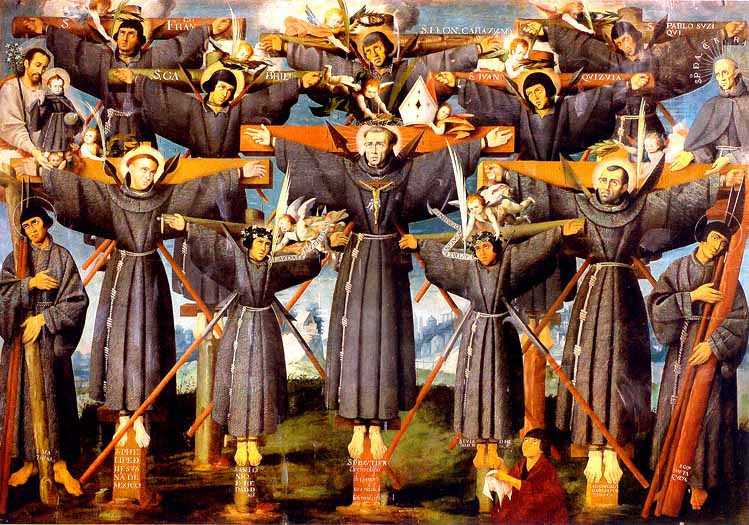
 Would someone die for a lie? Would someone willingly give up their life on account of falsehood? Would an act of martyrdom prove the veracity of a religious claim? A common Christian apologetic goes something like this: the apostles and the first Christians died for their belief in Jesus and his resurrection. This proves that Christianity was based on truth, since no one, the proponents of this argument insist, would be willing to die for what they know to be a lie. Is such reasoning sound?
Let us first consider the following:
- The New Testament records no deaths of any of the apostles or any of the original witnesses to the resurrected Jesus. Only later church tradition (the same tradition that has Peter as the first Pope of the Catholic Church) ascribes voluntary martyrdom to about half of the apostles, with the rest dying either a natural death or are supposedly murdered under various circumstances that did not require recanting of their beliefs. (There are various conflicting traditions, most put together long after the original disciples of Jesus were long dead one way or another.)
- The few people who actually did die for their faith in Jesus in the New Testament never witnessed Jesus’ resurrection themselves but came to believe through evangelistic efforts at a much later time. Stephen is one such example.
- Later generations of Christians became Jesus worshipers as a result of proselytism. When Romans made Christianity illegal, Christians were persecuted and sometimes executed by the Romans. However, they died not for what they themselves have witnessed but because they believed things they were taught by others and accepted them as truth.
Did they die for truth or did they die hoping that what they believed was true? A true believer does not ask such questions – he has all the answers, or so he thinks, in his holy scriptures. However, and it may come as a surprise to most Christians, the New Testament itself doesn’t give us a clear picture of Jesus’ claimed resurrection and who actually witnessed the events surrounding it. In fact, the New Testament’s account is incredibly muddied and conflicting between the different gospels. Mark, the earliest gospel in the New Testament, simply says that a young man at the empty grave announced to the visiting women that Jesus is “risen”, commanding them to go tell his disciples about it. Mark’s account stops at that, adding that the women fled, “said nothing to anyone, because they were afraid.” Did Jesus appear to someone later? The earliest manuscripts of Mark are silent about what happened next. Not to worry – the later Church scribes filled in the rest of the events (as can be seen in any NIV version of the NT, to the dismay of some Christians), adding interesting flourishes such as believers being given the power to handle of snakes and drinking poisons, and even the “Great Commission” for a good measure. Not to be outdone, the Church writers who penned and edited the other three gospels, Matthew, Luke and John, filled in even more of the details of post-resurrection appearances.
But let’s assume for a moment that Jesus was seen alive after his supposed resurrection. How did he appear to his close circle of disciples? Did he appear in a supposedly “resurrected body” as the gospel of John written many decades after Mark went on to claim? Or, perhaps Jesus appeared only as a ghost and not in a physical body. Did he appear to the group of 500 at the same time as Paul claims in 1 Corinthians 15:6 and was it only in a vision just like Paul’s (who, just a few verses later, also claimed to have seen Jesus, even though Jesus already left for heaven!) and is to each one individually? Did they all claim to see him during a mass apparition like the millions of modern Catholic Mary-devotees claim?
Which brings me to my original question – would people die for a lie that originated with themselves? Yes, if they have become convinced that the lie is true. Such a thing is certainly not unheard of and in fact quite common in a religious world. Consider the following examples from modern history:
- David Koresh, a self-proclaimed prophet of G-d and “son of G-d, the Lamb” and cult leader, was killed in a fire (probably started by either him or some members of his cult) after refusing to surrender to the authorities. He preferred to die a martyr’s death. Many of this followers died with him.
- Jim Jones, another Jesus Christ claimant, was a cult leader who led his whole congregation into murder-suicide. Jim Jones was reputed to perform many miracles, some of which were recorded on video.
- Marshall Applewhite, who referred to himself “I, Jesus—Son of God”, committed suicide along with the rest of this followers while waiting for a rendezvous with what they thought was a spaceship.
The individuals listed above created their own delusions and died in the process of living them out, firmly believing in their own ideas to the very end, taking many others along with them to destruction. They died for a lie that originated with themselves, somewhere in the process re-imagining their delusions as truth, unwilling to give them up even in the face of death. In fact, some of them welcomed death and martyrdom, enduring ridicule and persecution. None of these things made their convictions any more true, expect in their own minds. Countless people died for what they strongly believed to be true because others have convinced them. Millions of Germans died because they were convinced that they were a superior race and the millions of Japanese died to defend their demigod Emperor. History is replete with many other such examples, with time and space not permitting me to list them all here. Throughout humanity’s existence countless people had died for all sorts of reasons and causes – false, true and somewhere in between. Clearly then, dying for a belief, whether true or not, does not prove that a particular claim is true.


 Daily Minyan
Leave a comment