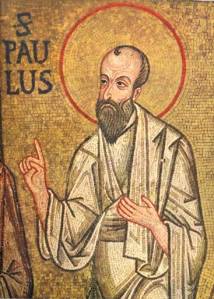
 Neither consistency nor his ability to explain were Apostle Paul’s strong points. Take these few gems of his for example:
But now, by dying to what once bound us, we have been released from the law so that we serve in the new way of the Spirit, and not in the old way of the written code. (Romans 7:6)
To the Jews I became like a Jew, to win the Jews. To those under the law I became like one under the law, though I myself am not under the law, so as to win those under the law. (1 Corinthians 9:20)
Numerous excuses for Paul are offered by messianics (who prefer to see Paul as “rabbi Shaul”) these days and I’ve heard them all (and even used them myself in my messianic days). “It’s not Torah that Paul meant, it’s “law of sin”. Or, “it’s not Torah, it’s the Jewish “legalism” he was against”, or “law of Christ is Torah too”, etc. Even if Paul somehow didn’t mean what he said, the way he said it is how his later disciples who came to understand him. Not just this verse, but many things he has written. Not thousands of years later, but in the very beginning of Christianity’s development. How early was the poor Paul “misunderstood”? Even the book of Acts, a whitewashing work of a Pauline apologist written at the end of first century (or even the beginning of the second, according to some scholars), records that this is how Jews in the first century understood Paul, which means that he was widely known even among Jewish Christians to be teaching against Torah from the very beginning!
Eusebius, a famous Church father, had this to report about the Jewish Christians’ view of Paul:
“These men, moreover, thought that it was necessary to reject all the epistles of the apostle [Paul], whom they called an apostate from the law; and they used only the so-called Gospel according to the Hebrews and made small account of the rest.” (325 CE, Eusebius, Ecclesiastical History 3.27)
In sum, we can sit here two thousand years later and revise history and pretend that all the Christian antagonism toward Judaism and Mosaic Covenant arose in a vacuum instead of drawing its support from the New Testament and especially the writings of Paul. Or, we can review evidence in regards to Jewish Christians who lived much closer to the time of Jesus, Paul and early Jewish Christianity – they seem to have been in a far better position to judge Paul for who he truly was than we are today.
Reading Paul’s own words in the NT is the best starting point to judge his true views on Torah. I used to make excuses for him in my messianic days, even when what he clearly wrote couldn’t have been come from a pen of a Torah-observant, faithful Jew. His comparison of the Mosaic Covenant to Hagar, slavery and those who are under it to slaves (Galatians 4:22-26) alone should give any thinking person a pause.
And how about another Paul’s favorite of mine:
“We are not like Moses, who would put a veil over his face to prevent the Israelites from seeing the end of what was passing away. But their minds were made dull, for to this day the same veil remains when the old covenant is read. It has not been removed, because only in Christ is it taken away. (2 Corinthians 3:14)
Here Paul not only completely re-interprets (is this another “midrash” of his?) the true reason why Moses covered his face (when the Torah plainly tells us that it glowed after he just came from G-d’s presence) as being one of the signs of passing away of the Mosaic Covenant (even though G-d just instituted it), but actually insists that Jews are blinded by the same covenant at the very moment G-d made it with them. The Jews are blind, according to Paul, even when they read “the old covenant” (by which he probably means Torah, I suppose, but that’s how Christians came to see Torah, as “old”) and that only Jesus can take away the Jewish blinders. The theme of “blind Jews” was common all throughout the Christian history and to this very day, we have Paul to thank for that.
Of course, Paul’s Gentile audience did not know any better! Paul was pulling a fast one on them to advance his cause, as has been the case with all religions based on man’s own ideas (and there were and are many), sort of like Joseph Smith of Mormonism (and countless others). And so Gentiles that Paul converted to his Christ-faith readily accepted his words as we read them today. They ate up his reinterpretations of biblical stories to paint Judaism and the Mosaic Covenant as dulling, blinding, ineffectual and obsolete. Christianity that resulted from this is still with us to this day – it didn’t arise in a vacuum – and it practically “worships” Paul and his teachings as G-d’s words, almost to the exclusion of anything else! And as history has so amply proven this is exactly how virtually everyone who has ever read Paul’s writings understood them, including today’s Torah-observant Jews themselves (who modern Pauline apologists insist should have understood his “midrash” better than anyone else).
Messianics claim today that “Paul’s Gentiles learned Torah from the synagogue and from Jewish teachers.” That’s another nice theory, probably based on James’ statement from Acts (a very late work) that Moses is being preached in every town. The reality is quite different. Paul was very particular about who had access to his converts. To that end, he set up his own churches with leadership composed of his disciples, complete with deacons, etc. Did Paul and his convert teachers teach Gentiles Torah, that is the way Jews would have learned it in his day? Why would they!? Paul believed that Torah wasn’t for the Gentiles under his care and neither he himself was obligated to observe it, as he made clear. But still, did they learn anything from Torah and the prophets? Yes, but only if one can consider Paul’s cristological reinterpretations of the Bible (as exemplified by his twisting of Deuteronomy 30:11-14 in Romans 10:6-13) as Torah!
I think that messianics who today wish to whitewash Paul and his deeds live in an imaginary world where Christianity never happened and where Paul was a great Torah teacher faithful to Judaism, “rabbi Shaul”. The reality is quite different. Paul probably founded hundreds of churches throughout the Asia Minor as well as in Europe and influenced their theology in every way. What did he teach them and how is it that they suddenly forget everything about the greatness of Torah and Judaism after Paul died? But we do know what he taught them, since we can read his lessons for them in the NT. He taught them that while Jews were useful and may convert to his Christ-faith one day (even though the true “seed” of Abraham was Jesus and not “seeds”, that is Jews as Paul “midrashed”), they were lost, they were blind, and they were slaves to Torah and Mosaic Covenant. More importantly, we know how quickly all of his churches turned anti-Jewish and anti-Torah. And guess what – at every turn it was Paul’s own writings that were used to justify all of it. We have observable history to examine of how Paul’s churches turned out in the long run, not theories of Paul’s modern apologists. Perhaps we should judge Paul and the effects of Paul’s teachings using Jesus’ own standard: “by their fruit you will recognize them.”.


 Daily Minyan
Leave a comment