 Some time ago one of the blog readers asked me to opine, as a former Jesus-believer and worshiper, on why I thought resurrection of Jesus became such an important event in Christian theology.
So, here are three reasons why I think Christianity placed such paramount importance on Jesus’ resurrection:
1. It allowed Christians to proclaim Jesus as still very much alive, both as god in the flesh and one who is in communion with G-d the Father. Being now forever alive, although a mortal man during his lifetime, Jesus became a divine figure which could be prayed to and worshiped as a deity. Of course, to the Jewish mind, such a notion was and remains idolatrous. It’s also important to note, however, that with proliferation of venerated (and oft petitioned) departed saints and martyrs within Catholic and Eastern Orthodox traditions, dead holy men who are seen as very much “alive” but only as spirits without bodies, Jesus’ own supposed bodily resurrection vs. a “mere” spiritual ascension doesn’t seem as so important or as practical a distinction for traditional Christians.
That it to say that it is not at all certain that the earliest Christians believed that Jesus was bodily resurrected. The earliest gospel we have in our possession, of Mark, doesn’t end with anyone seeing the resurrected Jesus at all, either in physical body or as a spirit. It seems that few Christians are even aware of this! Later church scribes, no doubt troubled by this glaring omission, added their own (if somewhat bizarre, as some readers note) ending of Jesus’ resurrected appearance as can be seen in all NIV versions.
Other synoptic gospels (Matthew and Luke) have Jesus behaving like a spirit. He appears out of nowhere and not even recognizable. Matthew 28:17 claims that some of those who “saw” the “resurrected” Jesus doubted it was him.
Paul was only seeing visions of “spiritual” Jesus since the physical Jesus had already ascended to the heavens by then according to the New Testmanent. However, this did not prevent Paul from claiming in 1 Corinthians 15 to have “seen Jesus”, just like the Apostles did:
He was seen by Peter and then by the Twelve. After that, he was seen by more than 500 of his followers at one time, most of whom are still alive, though some have died. Then he was seen by James and later by all the apostles. Last of all, as though I had been born at the wrong time, I also saw him.
Since Paul never met the resurrected Jesus “in the flesh” (who by then already ascended to G-d, according to the New Testament), this brings into question how exactly Jesus appeared to the apostles to begin with, as a spirit or as a flesh-and-blood man?!
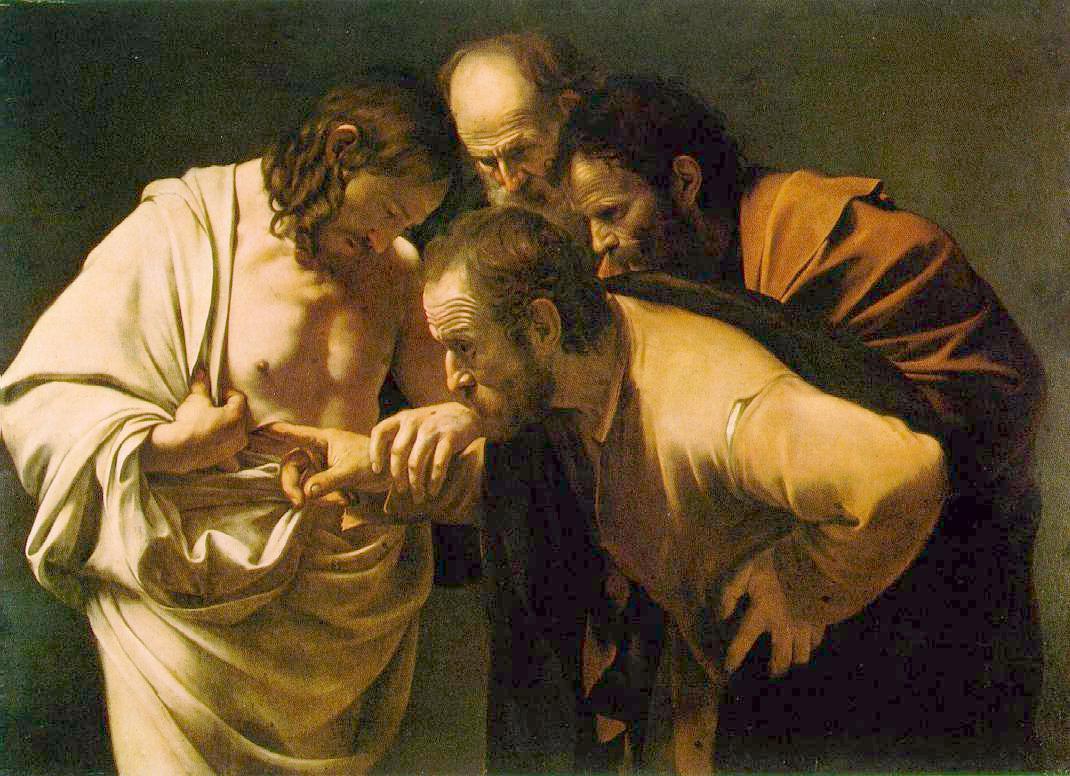
As already noted, Mark ends abruptly without anyone (at least no one human) seeing Jesus in the flesh after he has risen. Oddly enough, only when we turn to the so called “spiritual” gospel of John (the one that disagrees with the synoptic gospels in most factual and historical details), a work written at the end of the first or even perhaps at the beginning of second century that we see Jesus endowed with a truly physical body that can be touched, complete with wounds from the crucifixion, a body capable of eating food and even preparing breakfast for others! Jesus even tells his disciples that’s he no disembodied ghost!
2. The claimed bodily resurrection of Jesus served to the later Christians as confirmation and approval of his authority from G-d Himself. In the gospels, Jesus’ miraculous exploits served as confirmations that he was indeed from G-d (and not from the other “god”, that is Satan). Jesus specifically told those who questioned his authority to believe him because of his works (John 14:11). We might as well ask the following question: can there be such awesome things as miraculous healing and even resurrection without G-d approving of the person? Well….. according to the Book of Revelation the answer is yes! In Revelation:13:2-3 we see that (the Christian version of) Satan apparently has the power to heal and resuscitate! (I know, I know… it’s just a weird apocalyptic vision, but still…).
3. Resurrection of Jesus is important to Christianity because gives Christians assurance that because Jesus was resurrected from the dead, they too will one day be resurrected by Jesus upon his return. Jesus is referred to in the New Testament as a “firstborn from the dead” (Revelation 1:5). Of course, it’s easy to overlook that Jesus was not “mere man” but “god” and the “fact” that he lives on forever after his death in whatever form is not such a great achievement for a deity – many demigods of ancient religions had achieved this feat. Besides all this, most readers of the Hebrew Bible are already familiar with a few examples of the miraculously resurrected “truly human” dead. This means that even if Jesus was resurrected, he was not a pioneer in this particular area. Prophet Elijah resurrected the son of a widow. A dead man who touched the bones of Elisha also sprung back to life. Some object that their resurrections were not permanent and that they still died later one. However, in the Hebrew Bible we even have some people going up into heaven to be with G-d (long before Jesus supposed ascent to heaven) in way a superior way to Jesus’, that is even without first dying. These men are Enoch and Elijah.
As far as Jews are concerned, the great and permanent Resurrection will only happen at the very End, right before the so called Messianic Age. That Jesus, according to Christianity and without any outside evidence to confirm his resurrection as fact (quite conveniently, only his followers ever saw him alive after his execution!), got there first is meaningless to Jews – what good does it do for those who have been awaiting their turn for thousands of years and will not be resurrected any faster or better? They certainly didn’t need G-d Himself to make Himself into a man, to die and get resurrected just to confirm to them He would one day raise them from the dead. From a Jewish point of view, few things can be as absurd as that.
As for me personally, when I was a Christian/Messianic Jew, of course I fully believed (as is required by Christianity to be a believer in good standing) that Jesus was resurrected in a body. It was important to me for the same reasons I outlined above. After all, I trusted Paul who said in 1 Corinthians 15:19 that if Jesus didn’t get resurrected, the religion that Paul had been propagating was hopeless, so much so that Paul and his converts were “of all men most miserable”. I now see that Paul was right.


 Daily Minyan
Leave a comment